Uncategorized

Digital Transformation
Uncategorized

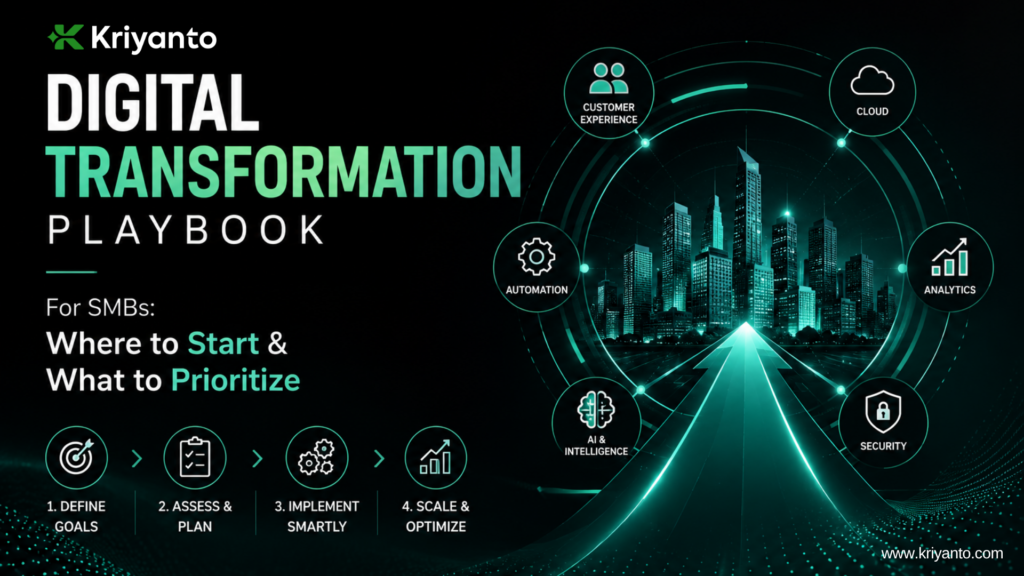
Digital Transformation Playbook for SMBs: Where to Start & What to Prioritize

Introduction Digital transformation has become one of the most overused terms in business. Every software vendor claims to enable it. Every consultant promises it. Every new technology is marketed as the next big breakthrough. Yet for many small and medium-sized businesses (SMBs), the concept still feels overwhelming. Where do you begin? Which technologies actually matter? How much should you invest? And perhaps the most important question of all: How do you ensure digital transformation generates measurable business value instead of becoming another expensive IT project? The truth is that digital transformation isn’t about buying more software. It isn’t about replacing people with automation. And it certainly isn’t about implementing every emerging technology simply because competitors are doing it. At its core, digital transformation is about making your business work better. It means removing inefficiencies that slow your teams down. It means creating better customer experiences. It means empowering employees with the right tools, connecting disconnected data, and enabling leaders to make decisions based on real-time insights instead of assumptions. For SMBs, the opportunity is enormous. Unlike large enterprises that often struggle with legacy systems and organizational complexity, smaller businesses have the advantage of agility. They can adopt modern technologies faster, adapt processes more quickly, and create customer experiences that rival much larger competitors. However, agility alone isn’t enough. Without a clear roadmap, businesses often end up investing in isolated applications that don’t integrate, automating inefficient processes, or implementing technologies that employees never fully adopt. According to industry research, one of the biggest reasons digital transformation initiatives fail isn’t because of poor technology—it’s because organizations begin with technology instead of business strategy. Successful transformation starts with understanding your business objectives. Technology simply becomes the vehicle that helps you achieve them. This comprehensive playbook is designed specifically for SMBs looking to modernize intelligently. Whether you’re planning your first CRM implementation, exploring Artificial Intelligence, investing in automation, or simply trying to eliminate operational inefficiencies, this guide will help you understand where to start, what to prioritize, and how to build a digital transformation strategy that continues delivering value for years to come. Let’s begin with an important misconception. Digital transformation isn’t actually about digital technology. It’s about business transformation. What Is Digital Transformation? (And What It Isn’t) Ask ten business leaders to define digital transformation and you’ll probably receive ten different answers. Some associate it with cloud computing. Others think it’s about Artificial Intelligence. Many believe it’s simply moving from spreadsheets to software. While all of these contribute to transformation, none of them truly define it. Digital transformation is the strategic use of technology to fundamentally improve how an organization operates, serves customers, empowers employees, and creates long-term business value. Notice that technology isn’t the objective. It’s the enabler. The real objective is creating a business that is: Think about a typical growing business. The sales team manages leads inside spreadsheets. Marketing uses separate email software. Customer support tracks requests through email. Finance works inside an ERP. Management relies on manually compiled reports every Monday morning. Every department works hard. But nobody works together. Information becomes fragmented. Customers repeat themselves. Employees duplicate work. Decision-making slows down. Digital transformation removes these disconnects. Instead of isolated systems, information flows across departments. Instead of manual reporting, dashboards update automatically. Instead of reacting to problems after they occur, organizations begin predicting and preventing them. The difference is profound. You’re no longer managing operations. You’re orchestrating them. Digital Transformation Is Not Just About Buying Software One of the biggest misconceptions among SMBs is believing that purchasing a CRM, ERP, or marketing automation platform automatically means they’ve undergone digital transformation. Nothing could be further from reality. Technology without process improvement is simply digitized inefficiency. Imagine automating an approval process that already contains five unnecessary steps. The process becomes faster. But it’s still inefficient. True digital transformation asks a different question: Should this process even exist in its current form? Sometimes the greatest improvement comes not from automation—but from simplification. Successful organizations redesign workflows before digitizing them. They eliminate bottlenecks. They remove duplicate approvals. They reduce unnecessary manual intervention. Only then do they automate. This mindset creates significantly better long-term outcomes. The Four Pillars of Successful Digital Transformation Every successful digital transformation initiative rests on four interconnected pillars. 1. People Technology never transforms businesses. People do. Employees need to understand why change is happening, how it benefits them, and how new tools improve their daily work. Organizations that invest in training, communication, and change management consistently outperform those that focus exclusively on technology implementation. Digital transformation should empower employees—not overwhelm them. 2. Processes Before implementing any software, evaluate your existing workflows. Ask questions like: Optimizing processes before digitization prevents organizations from automating inefficiency. 3. Technology Only after understanding people and processes should technology enter the conversation. The right technology should: Choosing technology because it’s popular is rarely the right strategy. Choosing technology because it solves a business problem almost always is. 4. Data Data is rapidly becoming the most valuable business asset. Yet many SMBs still struggle with: Modern digital transformation creates a unified data foundation that enables smarter decision-making across the organization. Without trustworthy data, even the most advanced AI solutions will produce unreliable outcomes. Why SMBs Need a Different Digital Transformation Strategy One of the biggest mistakes in digital transformation is assuming that what works for Fortune 500 companies will also work for growing businesses. It won’t. Large enterprises often have multi-million-dollar transformation budgets, dedicated innovation teams, enterprise architects, and lengthy implementation timelines. SMBs operate under completely different realities. Budgets are tighter. Teams wear multiple hats. Resources are limited. Every investment must demonstrate clear business value. Fortunately, SMBs possess something equally valuable. Agility. Unlike large organizations that often require months to approve a single technology decision, SMBs can evaluate, implement, and optimize new solutions much faster. This speed creates an enormous competitive advantage—but only if technology investments are prioritized correctly. Rather than attempting large-scale transformation all at once, successful SMBs focus on incremental improvements that compound over
Salesforce Summer ’26
Uncategorized

Salesforce Summer ’26: What It Really Means for Your Business (And Why It Matters Now)

Salesforce releases used to be about features. New tools. Small improvements. Incremental upgrades. That’s no longer the case. Salesforce Summer ’26, rolling out between May 9 and June 13, 2026, is a shift in how businesses operate. It’s not just about doing things faster—it’s about doing the right things automatically. If your teams are still spending hours pulling reports, manually updating records, or reacting to customer behavior after the fact, this release changes everything. Let’s break it down in a way that actually makes sense for business—not just for admins or developers. A Shift in Direction: From CRM Tool to Intelligent System There was a time when Salesforce acted like a powerful database. You stored information. You analyzed it. Then you acted. But there was always a gap. A delay. A dependency on manual effort. With Summer ’26, that gap starts to disappear. The platform is evolving into something far more dynamic—an intelligent system that guides action in real time. Instead of asking: The system tells you. And not just tells you—it prioritizes, recommends, and in some cases, acts automatically. That’s a fundamental change. AI Is No Longer a Feature—It’s the Foundation AI has been part of Salesforce for years. But previously, it felt like an add-on. Now, it’s embedded into the core experience. What’s different now? AI doesn’t wait for you to ask questions.It works quietly in the background, constantly analyzing patterns. For Sales Teams: No more guesswork. Just clarity. For Marketing Teams: Static campaigns are fading. Adaptive marketing is here. For Service Teams: The outcome is simple:less manual effort, more meaningful work. Automation Gets Smarter (And Easier) Automation used to feel powerful—but complex. It required planning, technical expertise, and constant adjustments. Summer ’26 changes that. What’s improved? The Real Upgrade: Intelligence Automation is no longer just rule-based. It becomes predictive. Example: Instead of: Now it becomes: This is proactive automation. And it scales beautifully across large datasets and complex processes. Breaking Silos: One Connected Ecosystem One of the biggest challenges in growing organizations? Disconnected teams. But they often operate on different data. That creates friction. Summer ’26 addresses this head-on. What changes? Data flows seamlessly across: Everyone works from the same source of truth. What does that mean in reality? No repetition. No confusion. No disconnect. Just one unified experience—for both teams and customers. A Better User Experience (Because Adoption Matters) Even the most powerful system fails if people don’t use it properly. Salesforce has clearly recognized this. What’s improved in Summer ’26? Why this matters: When systems are easier to use: And ultimately, ROI goes up. Performance That Keeps Up With Growth As businesses grow, systems often slow down. More data. More users. More complexity. Summer ’26 tackles this with meaningful performance upgrades. Improvements include: Why this matters: This might sound technical—but the impact is practical. Teams spend less time waiting.More time doing. And in fast-moving environments, speed matters. Stronger Data = Smarter Decisions Data is only valuable if it’s accurate. And many organizations struggle with: Summer ’26 introduces stronger data management capabilities. Key enhancements: The result: Your data becomes: Because bad data leads to bad decisions. Why This Release Matters Strategically It’s easy to look at a release and focus on features. But the real question is: What does this change for your business? Summer ’26 helps organizations: It’s about working smarter—not harder. And that’s where real growth happens. Real Impact Across Teams Let’s bring this down to real-world impact. Sales Teams: Marketing Teams: Service Teams: When every team improves, the business accelerates. Preparing for Salesforce Summer ’26 A release like this shouldn’t be taken lightly. Preparation is key. What should businesses do? The Kriyanto Perspective: Turning Features Into Business Value Salesforce releases offer potential. But potential alone doesn’t drive results. Execution does. Kriyanto helps organizations go beyond adoption and focus on outcomes. How Kriyanto supports businesses: The goal is simple:Turn every Salesforce update into measurable growth. Final Thoughts Salesforce Summer ’26 is not just an upgrade. It’s a clear signal of where CRM is heading. Toward: Businesses that adapt early will gain a significant advantage. Because in today’s environment, speed, intelligence, and experience define success. FAQs 1. What is Salesforce Summer ’26 Release? It is a major Salesforce update rolling out between May 9 and June 13, 2026, focused on AI, automation, performance, and user experience improvements. 2. When will Salesforce Summer ’26 be released? The rollout happens in phases between May and June 2026, depending on your Salesforce instance. 3. What is the biggest highlight of this release? The deeper integration of AI into everyday workflows across sales, marketing, and service. 4. How does this release impact sales teams? It improves lead prioritization, pipeline visibility, and reduces manual work. 5. What changes for marketing teams? Marketing becomes more dynamic with real-time segmentation and adaptive campaigns. 6. Is automation easier in Summer ’26? Yes, workflows are more intuitive and can handle complex processes with less effort. 7. Does this release improve performance? Yes, reports, dashboards, and overall responsiveness are significantly faster. 8. How does it improve customer experience? With unified data and AI insights, interactions become more personalized and consistent. 9. What should businesses do before the release? Test in sandbox, train teams, and review workflows to avoid disruptions. 10. Why should businesses work with Kriyanto? Kriyanto ensures Salesforce capabilities are aligned with business outcomes, driving real and measurable growth.

Salesforce Data 360
Uncategorized

Why Salesforce Data 360 Is the Heart of Real-Time Customer Intelligence

Salesforce Data 360 Customer expectations have changed dramatically. People expect brands to recognize them instantly, understand their preferences, and respond with precision. Not tomorrow. Not next week. Right now. That level of responsiveness requires something most companies still struggle with—real-time customer data. Disconnected systems, fragmented databases, and inconsistent records make it nearly impossible to see the full customer picture. This is where Salesforce Data Cloud—now often referred to as Data 360—changes the equation. Instead of scattered information, businesses get a unified customer profile. Instead of delayed analytics, they get real-time intelligence. And instead of guessing customer intent, they can predict and act on it instantly. Let’s explore why Data 360 has become the core engine of modern customer intelligence. Introduction: The Age of Real-Time Customer Intelligence Businesses once operated in a world where data was historical. Reports were generated weekly. Insights arrived late. Decisions were reactive. That model no longer works. Today’s digital environment moves at extraordinary speed. Customers interact with brands across websites, mobile apps, social platforms, emails, and physical stores—often within minutes. To respond intelligently, companies need real-time customer data. That is precisely what Salesforce Data Cloud (Data 360) delivers. Why Customer Data Is the Most Valuable Business Asset Modern organizations run on data. But not just any data—connected, contextual, real-time data. Customer data helps businesses understand: Without this intelligence, marketing becomes guesswork. Sales conversations lose relevance. Customer service struggles to resolve issues efficiently. When data is unified and accessible, something powerful happens. Every interaction becomes smarter. What Is Salesforce Data 360 (Formerly Data Cloud)? Salesforce Data Cloud—commonly referred to as Data 360—is a real-time customer data platform (CDP) designed to unify and activate customer information across the entire Salesforce ecosystem. Instead of storing data in isolated systems, Data 360 aggregates information from multiple sources and builds a single, living customer profile. That profile updates continuously as new interactions occur. In simple terms, Data 360 turns fragmented data into real-time customer intelligence. Why Salesforce Renamed It as Data 360 The name shift reflects a broader vision. Traditional CDPs primarily support marketing teams. Data 360 expands the value across marketing, sales, service, commerce, and analytics. It is not just about collecting customer data.It is about orchestrating the entire customer experience around that data. Hence the “360” concept—a complete, dynamic view of the customer. The Problem with Traditional Customer Data Platforms Many CDPs promise data unification but struggle with real-world complexity. Common issues include: These limitations prevent businesses from delivering real-time experiences. Traditional CDPs often become data warehouses rather than intelligence engines. How Data 360 Solves the Data Fragmentation Problem Data 360 was designed differently. It operates natively within the Salesforce platform and integrates seamlessly with other enterprise systems. Data flows continuously into the platform and updates profiles instantly. The result is a real-time customer graph. Instead of waiting for nightly data batches, companies gain immediate visibility into customer behavior. Understanding the Unified Customer Profile At the center of Data 360 lies the unified customer profile. This profile consolidates information from multiple systems: The platform then resolves identities and merges records into a single, accurate representation of each customer. No duplicates. No fragmentation. Just one clear customer view. The Power of Real-Time Customer Data Real-time data changes everything. Imagine a customer browsing a product page. Within seconds, the system can update their profile, adjust segmentation, and trigger a personalized offer. This level of immediacy enables brands to deliver contextual experiences at the exact moment of engagement. The difference between real-time data and delayed data can be the difference between conversion and abandonment. Customer 360: Seeing the Complete Customer Journey Customer 360 is not just a marketing concept. It is an operational capability. With Data 360, organizations can visualize the entire customer journey, from first interaction to long-term loyalty. Every touchpoint contributes to the story. And every department—marketing, sales, and service—works from the same data foundation. How Data 360 Connects the Entire Salesforce Ecosystem One of the strongest advantages of Data 360 is its native integration with Salesforce products. Customer data flows seamlessly into: This integration eliminates manual data transfers and ensures consistent insights across departments. Data Ingestion: Bringing All Your Data Together Data 360 supports massive-scale data ingestion. Organizations can import data from: All this data is standardized and mapped into a unified framework. Identity Resolution: Connecting Customer Identities Across Systems Customers often appear under multiple identities across different systems. Different emails. Multiple devices. Separate account IDs. Identity resolution technology analyzes these signals and merges them intelligently. The result is a single accurate customer identity across all channels. Real-Time Segmentation and Activation Segmentation used to be slow. Marketers built audience lists manually and scheduled campaigns days in advance. With Data 360, segmentation happens instantly. As customer behavior changes, segments update automatically. Campaigns can activate immediately. This creates hyper-responsive marketing operations. Personalization at Scale Using Data 360 Personalization becomes significantly more powerful when powered by real-time data. Instead of static customer segments, businesses can deliver dynamic experiences tailored to each individual. Emails change. Website content adapts. Product recommendations evolve. Every interaction feels intentional. How Data 360 Improves Marketing Performance Marketing teams gain extraordinary advantages with unified data. They can: Campaign performance improves because decisions are based on complete customer insight. Sales Teams Benefit from Real-Time Intelligence Sales representatives gain deeper visibility into customer activity. They can see: Armed with this intelligence, sales conversations become far more relevant. Relevance drives trust. Trust drives revenue. Service Teams Deliver Faster Support with Unified Data Customer service often suffers when agents lack context. Data 360 solves this by providing a full customer timeline. Agents immediately understand: Support becomes faster, smarter, and more empathetic. AI and Predictive Intelligence with Data 360 Real-time data fuels artificial intelligence. When AI models access unified customer profiles, they can predict behaviors with remarkable accuracy. Businesses can identify: This predictive intelligence transforms decision-making. Real-World Use Cases of Salesforce Data Cloud Key Benefits of Salesforce Data Cloud for Businesses Key advantages include: These benefits translate directly into better customer experiences and

Salesforce Einstein GPT
Uncategorized

How AI Is Changing CRM: Salesforce Einstein GPT Explained

Introduction: The AI Inflection Point in CRM Customer Relationship Management has evolved dramatically over the past decade. What once functioned as a static repository for contacts and transactions is now transforming into an adaptive intelligence engine. Artificial Intelligence is not merely enhancing CRM; it is redefining its ontological foundation. The modern enterprise no longer seeks incremental productivity. It demands prescriptive insights. It expects automation that anticipates, not reacts. In this new epoch, AI in CRM is the fulcrum of competitive differentiation. At the center of this transformation stands Einstein GPT, Salesforce’s generative AI capability embedded across Sales and Service Cloud. Why 2026 Is a Defining Moment for AI CRM AI CRM trends 2026 indicate a decisive shift from descriptive analytics to generative and predictive automation. Organizations are investing aggressively in AI-driven workflows because customer expectations have intensified. Customers want immediacy. Personalization. Contextual relevance. Meanwhile, sales cycles are elongating and service demands are becoming more intricate. Manual CRM operations cannot sustain this complexity. AI-infused CRM systems can. This convergence of demand pressure and technological maturity makes now the pivotal moment for Einstein GPT adoption. What Is Salesforce Einstein GPT? Einstein GPT is a generative AI capability integrated directly within Salesforce’s CRM ecosystem. It combines real-time customer data with advanced language models to produce contextual content, predictions, and automation inside workflows. It is not an external plugin. It is native. Seamless. Embedded. From Einstein AI to Generative CRM Traditional Einstein AI focused on predictive analytics—lead scoring, opportunity insights, and forecasting. Einstein GPT expands that horizon by introducing generative capabilities. It writes emails. Summarizes cases. Generates knowledge articles. Drafts responses. Predictive intelligence becomes creative intelligence. How Einstein GPT Works Inside Salesforce Einstein GPT leverages CRM data, Data Cloud unification, and secure large language models to generate contextual outputs within Sales Cloud and Service Cloud. A sales rep opens an opportunity. The system generates a tailored follow-up email.A service agent reviews a case. The system provides an instant summary. The intelligence is immediate. Actionable. Contextual. The Architecture Behind Einstein GPT Understanding architecture clarifies value. Data Cloud as the Intelligence Layer Salesforce Data Cloud harmonizes disparate data sources—CRM records, behavioral signals, transactional history—into a unified customer profile. This data unification forms the epistemic substrate upon which Einstein GPT operates. Without clean, harmonized data, generative AI lacks precision. Large Language Models and Secure Prompting Einstein GPT integrates enterprise-grade language models with secure data grounding. Sensitive customer information remains within Salesforce’s trusted environment. Security is not an afterthought. It is foundational. AI in Sales Cloud: A Paradigm Shift Sales teams are experiencing a metamorphosis driven by automation and predictive augmentation. AI-Powered Lead Scoring and Qualification Einstein GPT analyzes behavioral signals, engagement metrics, and historical conversion patterns to prioritize leads. Sales teams stop chasing noise.They focus on intent-rich prospects. This is algorithmic discernment in action. Intelligent Opportunity Insights AI identifies deal risks, competitor mentions, and stagnation patterns. It surfaces next-best actions. Instead of relying on intuition alone, sales leaders operate with probabilistic clarity. Auto-Generated Sales Emails and Follow-Ups Time is currency in sales. Einstein GPT drafts hyper-personalized outreach based on CRM context. Each message feels handcrafted. Yet it is generated in seconds. Predictive Forecasting and Pipeline Intelligence AI models analyze pipeline health and forecast revenue with increasing precision. Variance shrinks. Confidence grows. Forecast meetings become strategic discussions, not speculative debates. AI in Service Cloud: Reinventing Customer Support Customer service is shifting from reactive resolution to anticipatory engagement. AI-Generated Case Summaries Long case threads are condensed into coherent summaries. Agents understand context instantly. Resolution times decrease. Accuracy improves. Smart Knowledge Article Creation Einstein GPT converts resolved cases into knowledge articles automatically. Institutional knowledge compounds over time.Support ecosystems become self-improving. AI-Powered Chat and Virtual Agents Intelligent bots handle routine queries while escalating complex issues intelligently. Efficiency scales without proportional headcount growth. Sentiment Analysis and Escalation Triggers AI detects frustration in customer communication and flags high-risk cases. Escalation becomes proactive. Not reactive. Top Einstein GPT CRM Use Cases Each use case reduces friction. Each increases velocity. Real-World Business Benefits of Salesforce AI Salesforce AI benefits extend beyond efficiency. These are measurable, not theoretical outcomes. AI CRM Trends 2026: What Leaders Must Prepare For The trajectory points toward hyperautomation, autonomous workflows, and AI copilots embedded across every CRM function. Expect deeper integration with voice interfaces.Expect predictive churn prevention.Expect real-time revenue intelligence. Organizations that delay adoption risk obsolescence. Data, Ethics, and Responsible AI in CRM AI must operate within ethical guardrails. Transparency, auditability, and bias mitigation are imperative. Trust is the bedrock of CRM. AI should amplify it, not erode it. Measuring ROI: How to Quantify Salesforce AI Benefits ROI measurement must include: Dashboards must correlate AI adoption with business outcomes. Implementation Roadmap for Einstein GPT Adoption must be methodical, not impulsive. Common Challenges and How to Overcome Them Resistance to change. Data silos. Skill gaps. Overcome these with structured change management and executive sponsorship. Why AI Without Strategy Fails Technology is an enabler, not a panacea. Without clear objectives and KPIs, AI becomes ornamental. Strategic clarity precedes technological implementation. How Kriyanto Helps Businesses Operationalize AI in CRM Kriyanto enables enterprises to translate AI ambition into operational reality. From Salesforce architecture optimization to Einstein GPT deployment, strategic alignment remains central. The approach is consultative. Diagnostic. Outcome-oriented. Data readiness assessments. AI roadmap design. Custom workflow automation. Performance measurement frameworks. AI adoption is not about activating a feature. It is about engineering a transformation. The Future of Human + AI Collaboration in CRM AI will not replace sales representatives or service agents. It will augment them. Human empathy combined with machine intelligence creates asymmetric advantage. The future CRM is collaborative intelligence. Conclusion: CRM Is No Longer Static CRM systems have evolved from data repositories to intelligent ecosystems. Einstein GPT exemplifies this evolution. Organizations embracing AI in Sales and Service Cloud will lead markets. Those resisting will struggle to remain relevant. The transformation is underway. AI is redefining CRM architecture at an unprecedented pace. Businesses that act decisively will outpace competitors. Those that hesitate will

Get 30% off your first purchase

X
Scroll to Top