
Introduction
Digital transformation has become one of the most overused terms in business.
Every software vendor claims to enable it. Every consultant promises it. Every new technology is marketed as the next big breakthrough.
Yet for many small and medium-sized businesses (SMBs), the concept still feels overwhelming.
Where do you begin?
Which technologies actually matter?
How much should you invest?
And perhaps the most important question of all:
How do you ensure digital transformation generates measurable business value instead of becoming another expensive IT project?
The truth is that digital transformation isn’t about buying more software. It isn’t about replacing people with automation. And it certainly isn’t about implementing every emerging technology simply because competitors are doing it.
At its core, digital transformation is about making your business work better.
It means removing inefficiencies that slow your teams down. It means creating better customer experiences. It means empowering employees with the right tools, connecting disconnected data, and enabling leaders to make decisions based on real-time insights instead of assumptions.
For SMBs, the opportunity is enormous.
Unlike large enterprises that often struggle with legacy systems and organizational complexity, smaller businesses have the advantage of agility. They can adopt modern technologies faster, adapt processes more quickly, and create customer experiences that rival much larger competitors.
However, agility alone isn’t enough.
Without a clear roadmap, businesses often end up investing in isolated applications that don’t integrate, automating inefficient processes, or implementing technologies that employees never fully adopt.
According to industry research, one of the biggest reasons digital transformation initiatives fail isn’t because of poor technology—it’s because organizations begin with technology instead of business strategy.
Successful transformation starts with understanding your business objectives.
Technology simply becomes the vehicle that helps you achieve them.
This comprehensive playbook is designed specifically for SMBs looking to modernize intelligently. Whether you’re planning your first CRM implementation, exploring Artificial Intelligence, investing in automation, or simply trying to eliminate operational inefficiencies, this guide will help you understand where to start, what to prioritize, and how to build a digital transformation strategy that continues delivering value for years to come.
Let’s begin with an important misconception.
Digital transformation isn’t actually about digital technology.
It’s about business transformation.
Table of Contents
- Introduction
- How do you ensure digital transformation generates measurable business value instead of becoming another expensive IT project?
- What Is Digital Transformation? (And What It Isn’t)
- Digital Transformation Is Not Just About Buying Software
- The Four Pillars of Successful Digital Transformation
- Why SMBs Need a Different Digital Transformation Strategy
- Why “Start Small, Scale Fast” Works Better
- Step 1: Start With Business Goals, Not Technology
- Step 2: Assess Your Current Digital Maturity
- Step 3: Identify High-Impact Business Processes
- Step 4: Put Customer Experience at the Center of Every Decision
- Step 5: Choose Technology That Can Grow With Your Business
- Step 6: Modernize Your CRM—Your Most Valuable Business Platform
- Step 7: Automate Repetitive Work So Your Teams Can Focus on Growth
- Step 8: Use AI to Make Better Decisions—Not Just Faster Decisions
- Where SMBs Can Use AI Today
- AI Is Only as Good as Your Data
- Step 9: Build a Data-Driven Organization
- Create a Single Source of Truth
- Measure What Actually Matters
- Step 10: Strengthen Security, Compliance, and Governance
- Build Security Into Every Project
- Establish Data Governance
- A Practical 30-60-90-180 Day Digital Transformation Roadmap
- First 30 Days – Discovery and Assessment
- Days 31–60 – Strategy and Prioritization
- Days 61–90 – Initial Implementation
- Days 91–180 – Scale and Optimize
- Common Digital Transformation Mistakes SMBs Should Avoid
- Trying to Transform Everything at Once
- Ignoring Employee Adoption
- Automating Broken Processes
- Focusing Only on Technology
- Digital Transformation Across Different Industries
- Manufacturing
- Retail
- Professional Services
- Healthcare
- Technology Companies
- Why Salesforce Is an Ideal Platform for SMB Digital Transformation
- How Kriyanto Helps SMBs Accelerate Digital Transformation
- Final Thoughts
- Frequently Asked Questions (FAQs)
- 1. What is digital transformation for SMBs?
- 2. Where should a small business begin its digital transformation journey?
- 3. Why is CRM important in digital transformation?
- 4. How can AI benefit small and medium-sized businesses?
- 5. What are the biggest challenges SMBs face during digital transformation?
- 6. How long does digital transformation typically take?
- 7. Which technologies should SMBs prioritize first?
- 8. How do you measure the success of digital transformation?
- 9. Why is change management important in digital transformation?
- 10. Why choose Kriyanto as your digital transformation partner?
What Is Digital Transformation? (And What It Isn’t)
Ask ten business leaders to define digital transformation and you’ll probably receive ten different answers.
Some associate it with cloud computing.
Others think it’s about Artificial Intelligence.
Many believe it’s simply moving from spreadsheets to software.
While all of these contribute to transformation, none of them truly define it.
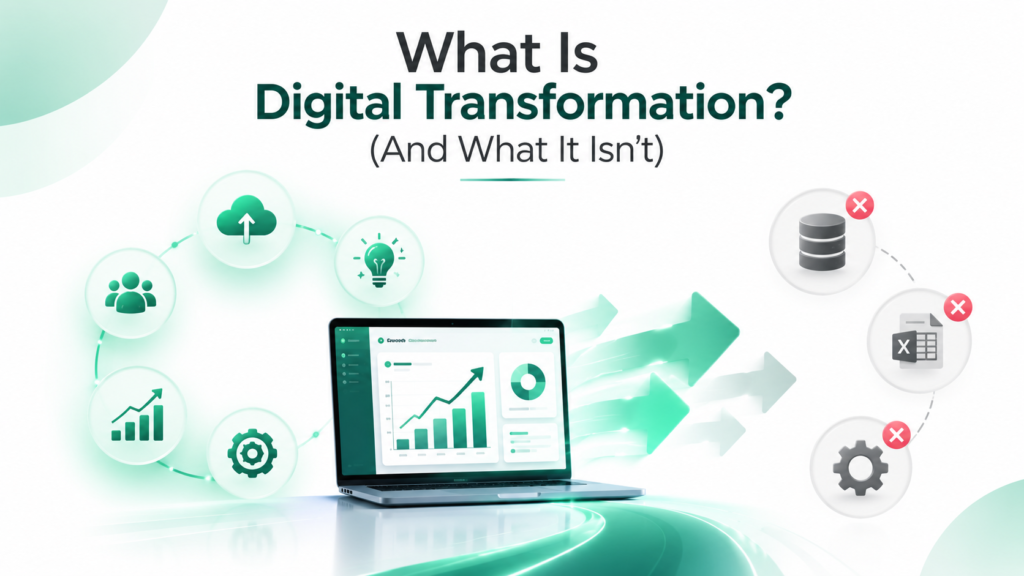
Digital transformation is the strategic use of technology to fundamentally improve how an organization operates, serves customers, empowers employees, and creates long-term business value.
Notice that technology isn’t the objective.
It’s the enabler.
The real objective is creating a business that is:
- More efficient
- More agile
- More customer-centric
- More scalable
- More resilient
- More data-driven
Think about a typical growing business.
The sales team manages leads inside spreadsheets.
Marketing uses separate email software.
Customer support tracks requests through email.
Finance works inside an ERP.
Management relies on manually compiled reports every Monday morning.
Every department works hard.
But nobody works together.
Information becomes fragmented.
Customers repeat themselves.
Employees duplicate work.
Decision-making slows down.
Digital transformation removes these disconnects.
Instead of isolated systems, information flows across departments.
Instead of manual reporting, dashboards update automatically.
Instead of reacting to problems after they occur, organizations begin predicting and preventing them.
The difference is profound.
You’re no longer managing operations.
You’re orchestrating them.
Digital Transformation Is Not Just About Buying Software
One of the biggest misconceptions among SMBs is believing that purchasing a CRM, ERP, or marketing automation platform automatically means they’ve undergone digital transformation.
Nothing could be further from reality.
Technology without process improvement is simply digitized inefficiency.
Imagine automating an approval process that already contains five unnecessary steps.
The process becomes faster.
But it’s still inefficient.
True digital transformation asks a different question:
Should this process even exist in its current form?
Sometimes the greatest improvement comes not from automation—but from simplification.
Successful organizations redesign workflows before digitizing them.
They eliminate bottlenecks.
They remove duplicate approvals.
They reduce unnecessary manual intervention.
Only then do they automate.
This mindset creates significantly better long-term outcomes.
The Four Pillars of Successful Digital Transformation
Every successful digital transformation initiative rests on four interconnected pillars.
1. People
Technology never transforms businesses.
People do.
Employees need to understand why change is happening, how it benefits them, and how new tools improve their daily work.
Organizations that invest in training, communication, and change management consistently outperform those that focus exclusively on technology implementation.
Digital transformation should empower employees—not overwhelm them.
2. Processes
Before implementing any software, evaluate your existing workflows.
Ask questions like:
- Which tasks consume the most time?
- Where do delays occur?
- Which approvals are unnecessary?
- What repetitive activities could be automated?
Optimizing processes before digitization prevents organizations from automating inefficiency.
3. Technology
Only after understanding people and processes should technology enter the conversation.
The right technology should:
- Integrate easily
- Scale with growth
- Improve collaboration
- Automate repetitive work
- Deliver actionable insights
- Support future innovation
Choosing technology because it’s popular is rarely the right strategy.
Choosing technology because it solves a business problem almost always is.
4. Data
Data is rapidly becoming the most valuable business asset.
Yet many SMBs still struggle with:
- Duplicate records
- Inconsistent customer information
- Disconnected databases
- Poor reporting
- Limited visibility
Modern digital transformation creates a unified data foundation that enables smarter decision-making across the organization.
Without trustworthy data, even the most advanced AI solutions will produce unreliable outcomes.
Why SMBs Need a Different Digital Transformation Strategy
One of the biggest mistakes in digital transformation is assuming that what works for Fortune 500 companies will also work for growing businesses.
It won’t.
Large enterprises often have multi-million-dollar transformation budgets, dedicated innovation teams, enterprise architects, and lengthy implementation timelines.
SMBs operate under completely different realities.
Budgets are tighter.
Teams wear multiple hats.
Resources are limited.
Every investment must demonstrate clear business value.
Fortunately, SMBs possess something equally valuable.
Agility.
Unlike large organizations that often require months to approve a single technology decision, SMBs can evaluate, implement, and optimize new solutions much faster.
This speed creates an enormous competitive advantage—but only if technology investments are prioritized correctly.
Rather than attempting large-scale transformation all at once, successful SMBs focus on incremental improvements that compound over time.
Instead of replacing every system simultaneously, they modernize one business function at a time.
Instead of chasing every emerging trend, they invest in technologies that solve immediate business challenges while supporting long-term growth.
This phased approach reduces risk, improves adoption, and delivers measurable ROI much sooner.
Why “Start Small, Scale Fast” Works Better
Many business owners believe digital transformation requires a complete organizational overhaul.
In reality, the most successful transformations often begin with a single business problem.
For example:
- A sales team struggling to manage leads implements a CRM.
- Marketing automates repetitive email campaigns.
- Customer support introduces a centralized case management system.
- Finance automates invoice approvals.
Each initiative delivers measurable improvements on its own.
Together, they create a connected digital ecosystem that continues evolving over time.
This approach not only minimizes disruption but also builds organizational confidence. Employees experience the benefits firsthand, making future technology adoption significantly easier.
Step 1: Start With Business Goals, Not Technology
One of the most common reasons digital transformation initiatives fail is surprisingly simple.
Businesses begin by shopping for technology instead of solving business problems.
A company attends a conference, reads about Artificial Intelligence, sees a competitor implementing a new CRM, or watches a product demo and immediately starts evaluating software.
The conversation becomes:
“Should we implement Salesforce?”
“Should we invest in AI?”
“Do we need automation?”
These are important questions—but they’re not the first questions you should ask.
Instead, ask yourself:
- What problems are slowing our business down today?
- Which processes frustrate our employees the most?
- Where are customers experiencing friction?
- What operational bottlenecks are limiting growth?
- Which activities consume the most manual effort?
- What business outcomes do we want to achieve over the next two years?
Notice the difference.
The discussion shifts from technology to business value.
Technology should always support business objectives—not define them.
Define Clear Business Outcomes
Every digital transformation initiative should begin with measurable goals.
For example:
- Reduce customer response times from 24 hours to 2 hours.
- Increase sales conversion rates by 20%.
- Reduce manual data entry by 60%.
- Improve customer retention by 15%.
- Generate reports in minutes instead of days.
- Automate repetitive administrative tasks.
These goals become the foundation for every technology decision that follows.
Without them, organizations often invest in powerful platforms that remain underutilized because no one clearly understands what success looks like.
Think Beyond Cost Savings
Many SMBs view digital transformation purely as a cost-reduction exercise.
While automation certainly reduces operational expenses, its greatest value often lies elsewhere.
Consider the broader business benefits:
- Better customer experiences
- Faster decision-making
- Improved employee satisfaction
- Increased business agility
- Higher revenue opportunities
- Stronger competitive positioning
Digital transformation should be viewed as a growth strategy—not simply an efficiency project.
Questions Every Leadership Team Should Answer
Before evaluating any technology, leadership should align on several strategic questions:
- Where do we want the business to be in three to five years?
- Which customer experiences need immediate improvement?
- What operational challenges are preventing growth?
- Which departments require modernization first?
- How will we measure success?
When leadership agrees on these answers, technology selection becomes significantly easier.
Step 2: Assess Your Current Digital Maturity
You can’t build an effective roadmap without understanding your starting point.
Many organizations assume they know where they stand digitally.
Often, they’re surprised.
Some businesses believe they’re highly digital because they use cloud software.
Others underestimate how much manual work still exists behind the scenes.
A digital maturity assessment provides an honest picture of your current capabilities.
It helps identify strengths, weaknesses, risks, and opportunities before major investments begin.
Evaluate Your Technology Landscape
Start by reviewing every system currently used across the organization.
Ask questions such as:
- Which platforms do employees use daily?
- Are systems integrated?
- Is customer information stored in multiple places?
- Which applications duplicate functionality?
- Where are employees relying on spreadsheets?
Many SMBs discover they own multiple software subscriptions that perform similar functions but never communicate with one another.
Instead of simplifying operations, disconnected technology creates additional complexity.
Review Business Processes
Technology alone doesn’t reveal maturity.
Processes do.
Map your critical workflows from beginning to end.
For example:
Lead Generation → Sales Qualification → Proposal → Customer Onboarding → Support
Now identify:
- Manual approvals
- Duplicate data entry
- Communication delays
- Process bottlenecks
- Frequent human errors
These become your highest-priority improvement areas.
Evaluate Employee Readiness
Digital transformation is as much about people as technology.
Consider:
- Are employees comfortable learning new tools?
- Do they understand current systems?
- Are there knowledge gaps?
- Which departments embrace change?
- Which departments may resist it?
Understanding organizational readiness helps shape training plans and change management strategies.
Assess Data Quality
Poor-quality data undermines every digital initiative.
Review:
- Duplicate customer records
- Missing information
- Outdated contacts
- Inconsistent naming conventions
- Incomplete sales histories
Remember:
Artificial Intelligence, automation, and analytics are only as good as the data powering them.
Step 3: Identify High-Impact Business Processes
One of the biggest mistakes SMBs make is trying to digitize everything simultaneously.
That’s rarely necessary.
Instead, focus on processes that create the greatest business impact.
The question isn’t:
“What can we automate?”
It’s:
“What should we automate first?”
Prioritize High-Value Activities
Look for processes that are:
- Time-consuming
- Highly repetitive
- Customer-facing
- Error-prone
- Difficult to scale
These typically produce the fastest ROI.
Sales Operations
Sales teams often spend more time updating CRM records than actually selling.
Common automation opportunities include:
- Lead assignment
- Opportunity creation
- Follow-up reminders
- Proposal generation
- Meeting scheduling
- Pipeline updates
Automating these administrative activities gives sales representatives more time to build relationships and close business.
Marketing Operations
Marketing teams frequently manage repetitive campaigns manually.
High-impact automation opportunities include:
- Email nurturing
- Lead scoring
- Customer segmentation
- Campaign reporting
- Event registrations
- Website personalization
These improvements not only save time but also create more consistent customer experiences.
Customer Service
Customer support presents enormous automation potential.
Examples include:
- Case routing
- Knowledge article recommendations
- Customer notifications
- SLA tracking
- Escalation workflows
- Feedback collection
Customers receive faster service while support teams handle greater volumes without increasing headcount.
Finance and Operations
Administrative departments often contain hidden efficiency opportunities.
Examples include:
- Invoice approvals
- Purchase requests
- Expense management
- Contract workflows
- Document approvals
Small improvements here often generate substantial operational savings.
Step 4: Put Customer Experience at the Center of Every Decision
Many organizations believe digital transformation is an internal initiative.
In reality, customers should be the primary beneficiaries.
Every investment should answer one simple question:
“How does this improve the customer experience?”
If technology makes life easier for employees but creates friction for customers, something has gone wrong.
Today’s Customers Expect More
Customer expectations have changed dramatically.
People expect:
- Immediate responses
- Personalized communication
- Consistent experiences
- Self-service options
- Real-time updates
- Omnichannel engagement
They’re comparing your business not only with competitors—but with companies like Amazon, Netflix, and Apple.
Those experiences shape expectations across every industry.
Map the Entire Customer Journey
Instead of optimizing individual touchpoints, map the complete experience.
For example:
- Discovery
- Website visit
- First inquiry
- Sales conversation
- Proposal
- Purchase
- Onboarding
- Customer support
- Renewal
- Advocacy
Now ask:
Where does frustration occur?
Where do customers wait?
Where do they repeat information?
Where do they abandon the journey?
Those friction points should become transformation priorities.
Personalization Is Becoming the Standard
Modern customers expect businesses to know them.
Not in an intrusive way—but in a helpful way.
They expect:
- Relevant recommendations
- Personalized emails
- Context-aware conversations
- Consistent experiences across channels
This is only possible when customer data is unified and accessible.
Step 5: Choose Technology That Can Grow With Your Business
Technology decisions should support where your business is going—not just where it is today.
Many SMBs choose software based solely on current requirements.
Within two years, they outgrow it.
Migration becomes expensive.
Adoption suffers.
Growth slows.
Think Long-Term
Ask questions like:
- Will this platform scale with additional users?
- Can it integrate with future systems?
- Does it support AI capabilities?
- Is automation built in?
- Does it provide analytics?
- Can it support international expansion?
Technology should become a growth accelerator—not a limitation.
Integration Matters More Than Features
Businesses often compare feature lists.
That’s important.
But integration is usually more valuable.
Disconnected applications create:
- Duplicate work
- Data inconsistencies
- Reporting challenges
- Poor customer experiences
A connected technology ecosystem creates operational efficiency across every department.
Cloud-First Is the New Standard
Cloud platforms offer:
- Lower infrastructure costs
- Automatic updates
- Better scalability
- Improved accessibility
- Enhanced security
- Faster innovation
For most SMBs, cloud-first strategies provide significantly greater long-term value than maintaining legacy on-premise systems.
Step 6: Modernize Your CRM—Your Most Valuable Business Platform
If digital transformation has a heart, it’s the CRM.
Your CRM shouldn’t simply store contacts.
It should become the central nervous system of your organization.
Every interaction.
Every opportunity.
Every customer conversation.
Every service request.
Every marketing engagement.
Everything connected.
Why CRM Modernization Matters
Many businesses still treat CRM as a digital address book.
Modern CRM platforms are far more capable.
They provide:
- Complete customer visibility
- Automated sales processes
- Marketing intelligence
- Customer service management
- AI-powered insights
- Revenue forecasting
- Performance analytics
Instead of multiple departments working independently, everyone collaborates around the same customer record.
Why Salesforce Remains the Gold Standard
For SMBs planning long-term growth, Salesforce offers capabilities that extend well beyond traditional CRM.
Organizations can gradually adopt:
- Sales Cloud
- Service Cloud
- Data 360
- Agentforce
- Experience Cloud
- Marketing solutions
- AI capabilities
- Analytics
This allows businesses to expand without replacing core systems.
Step 7: Automate Repetitive Work So Your Teams Can Focus on Growth
Employees rarely leave organizations because they work too hard.
They leave because they spend too much time doing work that adds little value.
Manual updates.
Copying data.
Sending reminder emails.
Following approval chains.
Generating repetitive reports.
These activities consume thousands of productive hours every year.
Automation gives those hours back.
Where Automation Creates Immediate Value
Look across every department.
Common automation opportunities include:
Sales:
- Lead assignment
- Opportunity updates
- Quote approvals
- Follow-up scheduling
Marketing:
- Email journeys
- Lead nurturing
- Customer segmentation
- Campaign triggers
Customer Service:
- Case routing
- Status notifications
- Escalations
- Satisfaction surveys
Finance:
- Invoice approvals
- Payment reminders
- Expense approvals
- Procurement workflows
Automation Doesn’t Replace People
This is one of the biggest misconceptions.
Automation removes repetitive work—not human expertise.
Employees spend less time clicking buttons.
More time solving problems.
More time innovating.
More time serving customers.
That’s where transformation creates its greatest value.
Step 8: Use AI to Make Better Decisions—Not Just Faster Decisions
Artificial Intelligence has moved well beyond the realm of large enterprises. What was once considered an expensive, experimental technology is now becoming a practical business tool for organizations of every size.
For SMBs, AI isn’t about replacing employees or building futuristic solutions overnight.
It’s about making everyday work smarter.
The businesses gaining the most value from AI aren’t necessarily using the most advanced models—they’re using AI to solve practical business problems.
Think about how much time employees spend every week searching for information, preparing reports, responding to repetitive emails, analyzing spreadsheets, qualifying leads, or identifying trends.
These are exactly the kinds of activities where AI creates immediate value.
Where SMBs Can Use AI Today
You don’t need a massive AI strategy to get started. Instead, begin with high-impact, low-complexity use cases.
Sales Intelligence
AI can continuously analyze customer interactions and identify buying signals that sales teams might otherwise miss.
Examples include:
- Prioritizing leads based on engagement behavior
- Predicting which opportunities are most likely to close
- Recommending the next best action for sales representatives
- Automatically summarizing customer meetings
- Drafting follow-up emails
- Identifying pipeline risks before they become revenue losses
Rather than replacing sales professionals, AI enables them to spend more time building relationships and less time managing administrative tasks.
Marketing Optimization
Modern marketing generates enormous amounts of data.
Understanding that data manually is becoming increasingly difficult.
AI helps marketers:
- Create audience segments automatically
- Recommend personalized content
- Predict campaign performance
- Optimize subject lines
- Generate campaign ideas
- Identify the most effective communication channels
Instead of launching static campaigns, marketing becomes adaptive and responsive.
Customer Service
AI significantly improves customer support by reducing response times while maintaining consistency.
Common applications include:
- Intelligent chatbots
- AI-powered knowledge search
- Suggested responses for agents
- Automatic case categorization
- Customer sentiment analysis
- Predictive service recommendations
Customers receive quicker responses, while service teams handle larger volumes without sacrificing quality.
Executive Decision-Making
Leadership teams often struggle with fragmented information.
AI can consolidate operational data and provide concise business summaries, highlight anomalies, identify trends, and surface opportunities that deserve immediate attention.
Instead of spending Monday mornings building reports, executives can focus on making strategic decisions.
AI Is Only as Good as Your Data
One important reality cannot be ignored.
Artificial Intelligence depends entirely on data quality.
If your customer information is incomplete, duplicated, or outdated, AI recommendations become unreliable.
That’s why successful AI initiatives always begin with strong data governance.
Before implementing AI, ensure your organization has:
- Clean customer records
- Standardized processes
- Integrated systems
- Reliable reporting
- Consistent data ownership
AI accelerates good decisions.
It also accelerates bad ones if poor-quality data powers it.
Step 9: Build a Data-Driven Organization
Many organizations claim to be data-driven.
In reality, they’re report-driven.
There’s an important difference.
Being report-driven means looking backward to understand what happened.
Being data-driven means using real-time insights to decide what should happen next.
The organizations growing fastest today are those that treat data as a strategic asset rather than an operational by-product.
Create a Single Source of Truth
One of the biggest challenges for SMBs is fragmented information.
Sales has one version of customer data.
Marketing has another.
Finance maintains separate records.
Customer support has its own system.
Eventually, nobody knows which information is accurate.
This leads to:
- Conflicting reports
- Duplicate work
- Poor customer experiences
- Slower decision-making
A modern digital ecosystem eliminates these silos by creating a unified view of customers, operations, and performance.
Measure What Actually Matters
Businesses often collect too much data and monitor too few meaningful metrics.
Instead of tracking everything, focus on KPIs directly linked to business outcomes.
Examples include:
Sales KPIs
- Lead conversion rate
- Average sales cycle
- Opportunity win rate
- Revenue growth
- Customer lifetime value
Marketing KPIs
- Customer acquisition cost
- Marketing-qualified leads
- Campaign ROI
- Website conversion rate
- Email engagement
Customer Service KPIs
- First response time
- Resolution time
- Customer Satisfaction Score (CSAT)
- Net Promoter Score (NPS)
- Customer retention rate
Operational KPIs
- Employee productivity
- Process completion time
- Automation savings
- Operational costs
- Workflow efficiency
The goal isn’t to collect more data.
It’s to make better decisions faster.
Step 10: Strengthen Security, Compliance, and Governance
As businesses become more digital, they also become more exposed to risk.
Cybersecurity is no longer an enterprise-only concern.
Small and medium-sized businesses are increasingly targeted because attackers often assume they have weaker security controls.
Digital transformation without governance creates unnecessary vulnerability.
Build Security Into Every Project
Security should never be added after implementation.
It should be part of every technology decision from the beginning.
Important considerations include:
- Role-based access controls
- Multi-factor authentication
- Data encryption
- Backup and disaster recovery
- Regular security audits
- Employee awareness training
A secure digital foundation protects both your business and your customers.
Establish Data Governance
Governance isn’t about restricting employees.
It’s about ensuring information remains accurate, secure, and trustworthy.
Every organization should define:
- Who owns customer data?
- Who can modify records?
- How is information validated?
- How frequently is data reviewed?
- How are compliance requirements maintained?
Strong governance increases confidence in every business decision.
A Practical 30-60-90-180 Day Digital Transformation Roadmap
One of the biggest questions SMBs ask is:
“Where do we actually begin?”
Rather than attempting a large-scale transformation, break the journey into manageable phases.
First 30 Days – Discovery and Assessment
Focus on understanding your business.
- Review existing systems
- Identify manual processes
- Map customer journeys
- Interview department heads
- Define business objectives
- Assess digital maturity
At this stage, don’t buy technology.
Build clarity.
Days 31–60 – Strategy and Prioritization
Once opportunities have been identified:
- Prioritize quick wins
- Select technology platforms
- Build an implementation roadmap
- Define KPIs
- Allocate budgets
- Prepare change management plans
This phase establishes the foundation for successful execution.
Days 61–90 – Initial Implementation
Begin with high-impact projects.
Examples include:
- CRM implementation
- Sales automation
- Marketing automation
- Customer service improvements
- Dashboard creation
Keep the scope manageable.
Early success builds organizational confidence.
Days 91–180 – Scale and Optimize
After initial deployment:
- Expand automation
- Introduce AI capabilities
- Improve reporting
- Refine workflows
- Train additional teams
- Measure ROI
- Optimize continuously
Digital transformation isn’t a one-time project.
It’s an ongoing capability.
Common Digital Transformation Mistakes SMBs Should Avoid
Many organizations fail not because they choose the wrong technology—but because they approach transformation incorrectly.
Avoid these common mistakes.
Trying to Transform Everything at Once
Large-scale transformations often overwhelm teams.
Instead, focus on incremental improvements that generate visible results.
Momentum matters.
Ignoring Employee Adoption
The best technology delivers little value if employees don’t use it.
Successful organizations invest heavily in:
- Training
- Communication
- Leadership support
- Continuous learning
People determine success—not software.
Automating Broken Processes
Automation should improve workflows—not preserve inefficient ones.
Simplify first.
Automate second.
Focusing Only on Technology
Technology is only one component.
Equal attention should be given to:
- Culture
- Leadership
- Process design
- Customer experience
- Change management
Digital transformation is ultimately a business initiative—not an IT initiative.
Digital Transformation Across Different Industries
Every industry has unique priorities.
However, the underlying principles remain remarkably similar.
Manufacturing
Manufacturers use digital transformation to:
- Improve production visibility
- Predict equipment maintenance
- Optimize inventory
- Connect supply chains
- Increase operational efficiency
Retail
Retail organizations focus on:
- Omnichannel commerce
- Personalized shopping experiences
- Inventory optimization
- Customer loyalty
- Real-time analytics
Professional Services
Consulting firms and agencies improve:
- Resource allocation
- Project delivery
- Client communication
- Revenue forecasting
- Knowledge management
Healthcare
Healthcare providers increasingly invest in:
- Patient engagement
- Appointment automation
- Secure data management
- Digital communication
- Operational efficiency
Technology Companies
Technology businesses leverage digital transformation to:
- Accelerate product development
- Improve customer onboarding
- Automate support
- Increase subscription retention
- Scale globally
Regardless of industry, the objective remains the same:
Deliver better experiences while operating more efficiently.
Why Salesforce Is an Ideal Platform for SMB Digital Transformation
Technology should grow alongside your business.
This is one reason Salesforce continues to be one of the most trusted digital transformation platforms worldwide.
Rather than implementing disconnected applications, businesses can build an integrated ecosystem that evolves over time.
With Salesforce, organizations can modernize:
- Sales operations
- Customer service
- Marketing
- AI capabilities
- Customer data
- Analytics
- Partner experiences
- Workflow automation
Instead of replacing systems every few years, businesses continue expanding the same trusted platform.
This creates long-term scalability while reducing implementation complexity.
How Kriyanto Helps SMBs Accelerate Digital Transformation
Technology alone doesn’t transform businesses.
Execution does.
That’s where Kriyanto makes the difference.
At Kriyanto, digital transformation isn’t approached as a software implementation project. It’s approached as a business growth strategy.
Every engagement begins with understanding your organization’s goals, challenges, customer expectations, and operational realities. From there, we design practical transformation roadmaps that deliver measurable outcomes—not just new technology.
Our Digital Transformation Services Include:
- Salesforce consulting and implementation
- CRM modernization and optimization
- Agentforce and AI adoption
- Salesforce Data 360 implementation
- Business process automation
- Customer experience transformation
- System integration
- Data strategy and analytics
- Digital transformation consulting
- Managed Salesforce services
Whether you’re implementing Salesforce for the first time, modernizing legacy systems, or exploring AI-powered customer experiences, Kriyanto helps you transform with confidence.
Ready to Future-Proof Your Business?
Digital transformation doesn’t have to be overwhelming.
With the right strategy, the right technology, and the right implementation partner, your business can become more agile, more efficient, and better prepared for sustainable growth.
Partner with Kriyanto to build a smarter, connected, and future-ready business powered by Salesforce, AI, automation, and intelligent digital solutions. Let’s turn your digital transformation vision into measurable business success.
Final Thoughts
Digital transformation isn’t a destination.
It’s an ongoing journey of continuous improvement.
The businesses that thrive over the next decade won’t necessarily be the largest or the ones with the biggest technology budgets.
They’ll be the organizations that learn faster, adapt quicker, make smarter decisions, and consistently improve customer experiences.
For SMBs, this presents an extraordinary opportunity.
You don’t need to transform everything overnight.
Start with a clear strategy.
Modernize one process at a time.
Empower your employees.
Connect your data.
Automate repetitive work.
Leverage AI where it creates real value.
Most importantly, focus on outcomes—not technology.
Because successful digital transformation isn’t measured by the number of platforms you implement.
It’s measured by the business value you create.
Frequently Asked Questions (FAQs)
1. What is digital transformation for SMBs?
Digital transformation for SMBs is the strategic adoption of technologies like CRM, cloud computing, AI, automation, and analytics to improve operations, enhance customer experiences, and support sustainable business growth.
2. Where should a small business begin its digital transformation journey?
Start by defining clear business goals, assessing your current digital maturity, identifying high-impact processes, and creating a phased implementation roadmap before investing in technology.
3. Why is CRM important in digital transformation?
A modern CRM acts as the central hub for customer information, enabling better collaboration, improved sales visibility, automated workflows, and data-driven decision-making across the organization.
4. How can AI benefit small and medium-sized businesses?
AI helps SMBs automate repetitive tasks, prioritize sales opportunities, personalize marketing, improve customer service, forecast demand, and provide actionable insights that support better business decisions.
5. What are the biggest challenges SMBs face during digital transformation?
Common challenges include resistance to change, poor data quality, disconnected systems, unclear objectives, limited budgets, and inadequate employee training. A structured roadmap helps overcome these obstacles.
6. How long does digital transformation typically take?
Digital transformation is an ongoing process rather than a one-time project. Many SMBs begin seeing measurable results within three to six months by implementing changes in phases.
7. Which technologies should SMBs prioritize first?
Most businesses should prioritize CRM, cloud-based collaboration tools, workflow automation, business intelligence, cybersecurity, and AI-powered solutions that align with their immediate business goals.
8. How do you measure the success of digital transformation?
Success should be measured using business KPIs such as revenue growth, customer satisfaction, operational efficiency, employee productivity, customer retention, sales cycle reduction, and return on technology investment.
9. Why is change management important in digital transformation?
Even the best technology can fail without employee adoption. Effective change management ensures users understand the value of new systems, receive proper training, and embrace new ways of working.
10. Why choose Kriyanto as your digital transformation partner?
Kriyanto combines deep Salesforce expertise with AI, automation, CRM modernization, integration, and digital strategy consulting to help SMBs implement scalable solutions that deliver measurable business outcomes, faster ROI, and long-term competitive advantage.and measurable growth.
