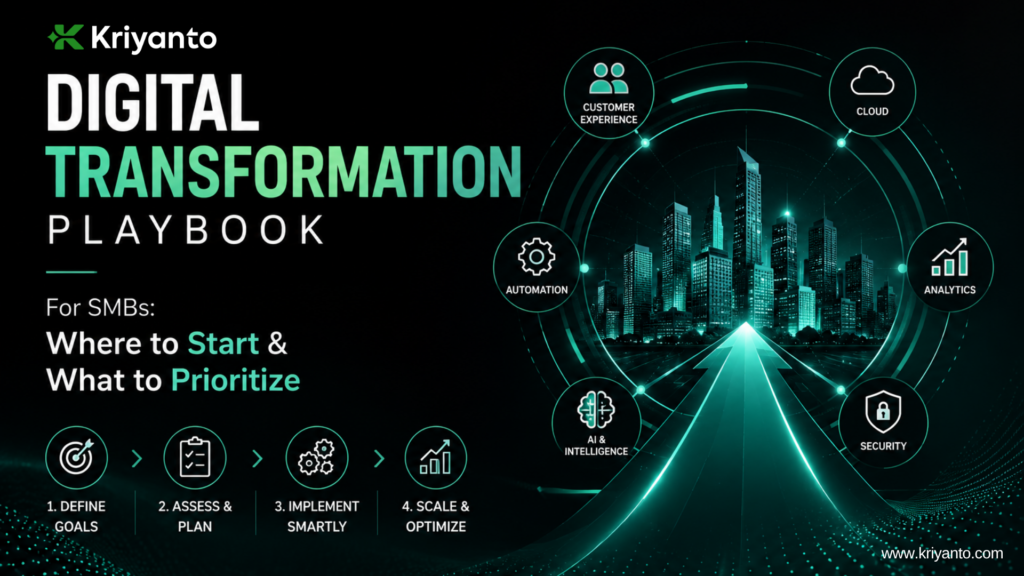
Digital Transformation Playbook for SMBs: Where to Start & What to Prioritize
Introduction Digital transformation has become one of the most overused terms in business. Every software vendor claims to enable it. Every consultant promises it. Every new technology is marketed as the next big breakthrough. Yet for many small and medium-sized businesses (SMBs), the concept still feels overwhelming. Where do you begin? Which technologies actually matter? How much should you invest? And perhaps the most important question of all: How do you ensure digital transformation generates measurable business value instead of becoming another expensive IT project? The truth is that digital transformation isn’t about buying more software. It isn’t about replacing people with automation. And it certainly isn’t about implementing every emerging technology simply because competitors are doing it. At its core, digital transformation is about making your business work better. It means removing inefficiencies that slow your teams down. It means creating better customer experiences. It means empowering employees with the right tools, connecting disconnected data, and enabling leaders to make decisions based on real-time insights instead of assumptions. For SMBs, the opportunity is enormous. Unlike large enterprises that often struggle with legacy systems and organizational complexity, smaller businesses have the advantage of agility. They can adopt modern technologies faster, adapt processes more quickly, and create customer experiences that rival much larger competitors. However, agility alone isn’t enough. Without a clear roadmap, businesses often end up investing in isolated applications that don’t integrate, automating inefficient processes, or implementing technologies that employees never fully adopt. According to industry research, one of the biggest reasons digital transformation initiatives fail isn’t because of poor technology—it’s because organizations begin with technology instead of business strategy. Successful transformation starts with understanding your business objectives. Technology simply becomes the vehicle that helps you achieve them. This comprehensive playbook is designed specifically for SMBs looking to modernize intelligently. Whether you’re planning your first CRM implementation, exploring Artificial Intelligence, investing in automation, or simply trying to eliminate operational inefficiencies, this guide will help you understand where to start, what to prioritize, and how to build a digital transformation strategy that continues delivering value for years to come. Let’s begin with an important misconception. Digital transformation isn’t actually about digital technology. It’s about business transformation. What Is Digital Transformation? (And What It Isn’t) Ask ten business leaders to define digital transformation and you’ll probably receive ten different answers. Some associate it with cloud computing. Others think it’s about Artificial Intelligence. Many believe it’s simply moving from spreadsheets to software. While all of these contribute to transformation, none of them truly define it. Digital transformation is the strategic use of technology to fundamentally improve how an organization operates, serves customers, empowers employees, and creates long-term business value. Notice that technology isn’t the objective. It’s the enabler. The real objective is creating a business that is: Think about a typical growing business. The sales team manages leads inside spreadsheets. Marketing uses separate email software. Customer support tracks requests through email. Finance works inside an ERP. Management relies on manually compiled reports every Monday morning. Every department works hard. But nobody works together. Information becomes fragmented. Customers repeat themselves. Employees duplicate work. Decision-making slows down. Digital transformation removes these disconnects. Instead of isolated systems, information flows across departments. Instead of manual reporting, dashboards update automatically. Instead of reacting to problems after they occur, organizations begin predicting and preventing them. The difference is profound. You’re no longer managing operations. You’re orchestrating them. Digital Transformation Is Not Just About Buying Software One of the biggest misconceptions among SMBs is believing that purchasing a CRM, ERP, or marketing automation platform automatically means they’ve undergone digital transformation. Nothing could be further from reality. Technology without process improvement is simply digitized inefficiency. Imagine automating an approval process that already contains five unnecessary steps. The process becomes faster. But it’s still inefficient. True digital transformation asks a different question: Should this process even exist in its current form? Sometimes the greatest improvement comes not from automation—but from simplification. Successful organizations redesign workflows before digitizing them. They eliminate bottlenecks. They remove duplicate approvals. They reduce unnecessary manual intervention. Only then do they automate. This mindset creates significantly better long-term outcomes. The Four Pillars of Successful Digital Transformation Every successful digital transformation initiative rests on four interconnected pillars. 1. People Technology never transforms businesses. People do. Employees need to understand why change is happening, how it benefits them, and how new tools improve their daily work. Organizations that invest in training, communication, and change management consistently outperform those that focus exclusively on technology implementation. Digital transformation should empower employees—not overwhelm them. 2. Processes Before implementing any software, evaluate your existing workflows. Ask questions like: Optimizing processes before digitization prevents organizations from automating inefficiency. 3. Technology Only after understanding people and processes should technology enter the conversation. The right technology should: Choosing technology because it’s popular is rarely the right strategy. Choosing technology because it solves a business problem almost always is. 4. Data Data is rapidly becoming the most valuable business asset. Yet many SMBs still struggle with: Modern digital transformation creates a unified data foundation that enables smarter decision-making across the organization. Without trustworthy data, even the most advanced AI solutions will produce unreliable outcomes. Why SMBs Need a Different Digital Transformation Strategy One of the biggest mistakes in digital transformation is assuming that what works for Fortune 500 companies will also work for growing businesses. It won’t. Large enterprises often have multi-million-dollar transformation budgets, dedicated innovation teams, enterprise architects, and lengthy implementation timelines. SMBs operate under completely different realities. Budgets are tighter. Teams wear multiple hats. Resources are limited. Every investment must demonstrate clear business value. Fortunately, SMBs possess something equally valuable. Agility. Unlike large organizations that often require months to approve a single technology decision, SMBs can evaluate, implement, and optimize new solutions much faster. This speed creates an enormous competitive advantage—but only if technology investments are prioritized correctly. Rather than attempting large-scale transformation all at once, successful SMBs focus on incremental improvements that compound over