
Modern marketing has entered an era of accountability. Budgets are no longer experimental playgrounds. They are scrutinized growth instruments. Boards demand clarity. CMOs demand provable ROI. Growth marketers are expected to generate pipeline with precision and optimize performance with scientific rigor.
This is where Salesforce and its evolution into Agentforce Marketing capabilities become transformational. Agentforce Marketing represents a new paradigm—AI-powered campaign orchestration, intelligent automation, and real-time personalization designed to convert engagement into revenue.
This guide explores how growth marketers can leverage Agentforce Marketing to orchestrate high-performing campaigns, automate intelligently, personalize at scale, and meet the ROI expectations of modern CMOs.
- The New Mandate for Growth Marketers
- Why CMOs Demand ROI from Martech Investments
- What Is Agentforce Marketing?
- Core Components of Agentforce Marketing
- Understanding Campaign Orchestration
- Designing Omnichannel Customer Journeys
- Personalization at Scale: The Competitive Advantage
- Data-Driven Segmentation Strategies
- Email Automation Best Practices
- Behavioral Trigger Marketing
- AI and Predictive Intelligence in Agentforce
- Marketing Automation Trends Shaping 2026
- Integrating Agentforce Marketing with Salesforce CRM
- Measuring ROI and Attribution Accurately
- Deliverability, Compliance, and Data Governance
- Building a High-Performance Content Strategy
- Common Implementation Pitfalls to Avoid
- Scaling Automation Without Losing Authenticity
- Creating a Growth-Focused Marketing Operating Model
- Future-Proofing Your Agentforce Investment
- Conclusion
- FAQs
- 1. What is Agentforce Marketing?
- 2. How does Agentforce differ from traditional marketing automation?
- 3. Can Agentforce improve email automation performance?
- 4. Is Agentforce suitable for B2B and B2C?
- 5. How does Agentforce support personalization?
- 6. What marketing automation trends align with Agentforce?
- 7. How can ROI be measured effectively?
- 8. Does Agentforce require CRM integration?
- 9. How long does implementation take?
- 10. Why choose Kriyanto for Agentforce implementation?
The New Mandate for Growth Marketers
Growth marketing is no longer about running isolated experiments and hoping for lift. It is about structured experimentation guided by data intelligence. Every campaign must align with revenue targets. Every channel must justify spend. Every automation must drive measurable performance.
Short bursts of creativity are not enough. Sustainable growth requires operational excellence. Growth marketers must operate at the intersection of analytics, psychology, and automation.
Agentforce Marketing equips teams with AI agents that analyze engagement patterns, suggest optimizations, and automate execution. The marketer’s role shifts from manual campaign builder to strategic orchestrator. This evolution is not optional. It is inevitable.
Why CMOs Demand ROI from Martech Investments
Martech stacks have expanded dramatically over the past decade. Tools proliferated. Subscriptions accumulated. Yet revenue attribution often remained ambiguous.
CMOs now demand:
- Clear linkage between marketing activity and pipeline
- Visibility into multi-touch attribution
- Reduced customer acquisition costs
- Improved lifetime value
Agentforce Marketing addresses this accountability gap. By embedding AI-driven analytics directly into campaign orchestration, it connects engagement metrics to revenue outcomes.
Marketing is no longer a cost center. It becomes a quantifiable growth engine.
What Is Agentforce Marketing?
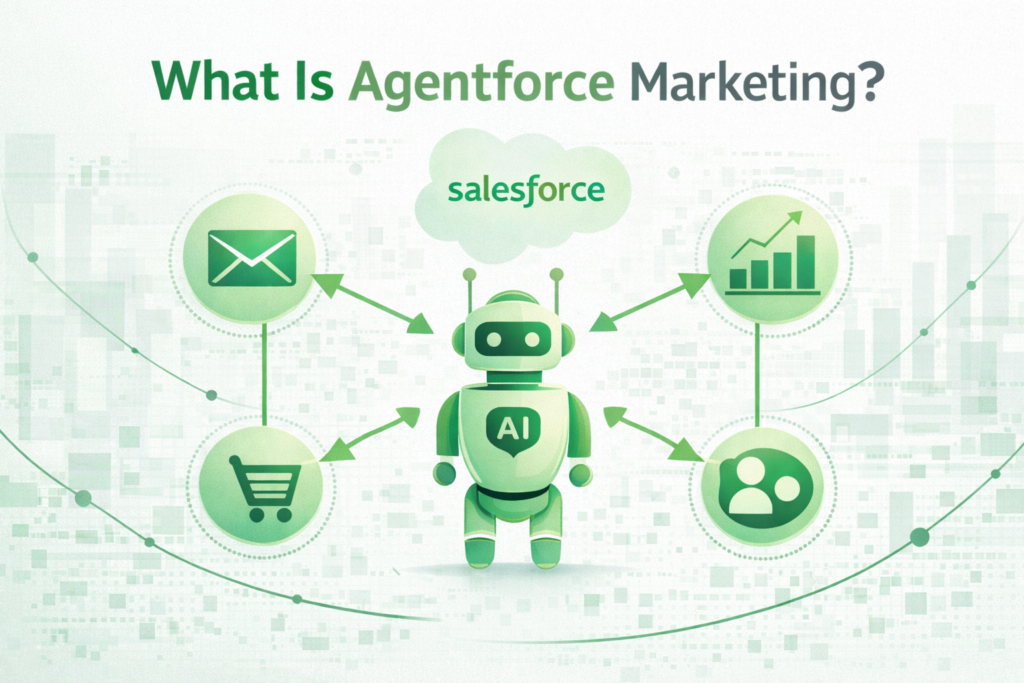
Agentforce Marketing is an AI-powered marketing orchestration layer within Salesforce that leverages autonomous agents to manage campaigns, optimize messaging, and enhance customer journeys.
Unlike traditional automation platforms that rely solely on pre-configured workflows, Agentforce introduces adaptive intelligence. It analyzes real-time data, predicts next-best actions, and refines journeys autonomously.
The result is not static automation. It is dynamic orchestration.
Core Components of Agentforce Marketing
AI Campaign Agents
AI agents monitor performance metrics continuously. They recommend subject line improvements, audience refinements, and timing optimizations. They act as digital strategists, augmenting human decision-making.
Campaign intelligence becomes proactive rather than reactive.
Journey Orchestration Engine
The orchestration engine maps customer touchpoints across email, SMS, paid ads, and web personalization. Decision nodes adapt based on behavior. Journeys feel intuitive because they are behaviorally responsive.
Automation Framework
Automation extends beyond scheduled sends. It includes triggered sequences, lifecycle-based campaigns, and AI-driven optimizations that adjust based on performance patterns.
Operational friction diminishes.
Unified Data Layer
Agentforce leverages Salesforce’s unified data architecture to consolidate CRM, behavioral, transactional, and engagement data. Identity resolution ensures every interaction enriches a single customer profile.
Personalization begins with data integrity.
Understanding Campaign Orchestration
Campaign orchestration is the synchronized management of multiple marketing channels to deliver a cohesive customer experience.
In fragmented systems, email campaigns operate independently from paid ads. Social media functions separately from CRM. This disjointed approach weakens messaging consistency.
Agentforce Marketing unifies these touchpoints. If a prospect downloads a whitepaper, the system can trigger a follow-up email, retargeting ad, and sales notification simultaneously.
It is choreography, not chaos.
Designing Omnichannel Customer Journeys
Customers navigate fluidly between devices and channels. They begin research on mobile. They compare options on desktop. They respond to email reminders. They convert after seeing a retargeting ad.
Omnichannel journey design ensures continuity across these interactions. Agentforce Marketing dynamically adjusts messaging based on prior engagement.
For example, if a customer ignores two promotional emails, the AI may shift tone or alter timing. If they engage heavily, it accelerates progression toward conversion.
Journeys become adaptive ecosystems rather than rigid funnels.
Personalization at Scale: The Competitive Advantage
Personalization is no longer a novelty. It is expected.
Agentforce Marketing enables dynamic content insertion based on behavioral triggers, geographic data, industry segmentation, and predictive scoring. AI agents analyze historical engagement to determine optimal messaging formats.
Hyper-relevance drives higher open rates, stronger click-through performance, and increased conversions. Personalization transforms marketing from broadcast to dialogue.
Relevance is revenue.
Data-Driven Segmentation Strategies
Traditional segmentation relied on static demographic filters. Modern segmentation demands behavioral and predictive nuance.
Agentforce Marketing supports segmentation based on:
- Engagement recency
- Purchase frequency
- Website interaction depth
- Content consumption patterns
- Predictive conversion likelihood
AI continuously refines segments as new data emerges. Audiences evolve. Messaging evolves with them.
Precision targeting reduces fatigue and increases response rates.
Email Automation Best Practices
Email remains the cornerstone of digital marketing ROI. However, execution quality determines performance.
Best practices include:
- Behavior-Based Triggers – Automate follow-ups based on pricing page visits, webinar registrations, or cart abandonment.
- Dynamic Personalization – Tailor subject lines and body content based on engagement history.
- Deliverability Optimization – Authenticate domains, monitor sender reputation, and maintain clean lists.
- Progressive Profiling – Gradually collect deeper data insights over time.
Agentforce AI agents continuously test and optimize subject lines, send times, and content variations. Automation becomes iterative and self-improving.
Behavioral Trigger Marketing
Behavior is the clearest indicator of intent.
When a user spends extended time on a pricing page, it signals purchase consideration. When a subscriber reopens an onboarding email, it signals interest.
Agentforce Marketing captures these micro-signals in real time. AI agents determine next-best actions—perhaps a demo invitation or a limited-time offer.
Speed matters. Context matters more.
AI and Predictive Intelligence in Agentforce
AI capabilities within Agentforce elevate marketing beyond manual optimization.
Predictive scoring identifies high-value prospects. Send-time optimization increases open probability. Content recommendations adapt to behavioral patterns.
These AI models learn continuously. They refine predictions. They enhance targeting.
Marketing evolves from reactive campaign management to anticipatory engagement.
Marketing Automation Trends Shaping 2026
The marketing landscape continues to transform rapidly. Key trends include:
- AI-driven journey optimization
- Privacy-first data strategies
- Zero-party data enrichment
- Composable Martech ecosystems
- Real-time customer intelligence
Agentforce aligns seamlessly with these trends. Its AI-first architecture ensures adaptability in a privacy-conscious, data-driven environment.
Integrating Agentforce Marketing with Salesforce CRM
Integration between Agentforce Marketing and Salesforce CRM eliminates silos.
Sales teams gain visibility into marketing engagement history. Marketing teams track opportunity progression and revenue outcomes.
Closed-loop reporting becomes standard practice. Attribution clarity improves budget allocation.
Alignment strengthens performance across departments.
Measuring ROI and Attribution Accurately
ROI measurement extends beyond open rates and click metrics.
Agentforce Marketing enables tracking of:
- Pipeline influence
- Revenue contribution
- Customer acquisition cost
- Retention rates
- Expansion revenue
Multi-touch attribution models clarify which channels drive incremental impact. Data informs strategic resource allocation.
Performance becomes transparent.
Deliverability, Compliance, and Data Governance
Automation without governance is dangerous.
Agentforce Marketing enforces compliance protocols, manages consent preferences, and ensures encryption of sensitive data. GDPR and CAN-SPAM adherence remain foundational.
Protecting brand reputation is non-negotiable. Trust fuels long-term growth.
Building a High-Performance Content Strategy
Technology amplifies content quality. It cannot compensate for mediocrity.
Develop modular assets adaptable across channels. Align messaging with lifecycle stages. Maintain tonal consistency.
Agentforce AI can recommend optimal formats, but creative resonance must remain intentional.
Compelling content converts.
Common Implementation Pitfalls to Avoid
Avoid overcomplication during implementation. Resist automating every process simultaneously. Ensure data hygiene before scaling automation.
Align stakeholders early. Define KPIs clearly. Audit performance regularly.
Technology magnifies strengths—and exposes weaknesses.
Scaling Automation Without Losing Authenticity
Automation enhances efficiency. Authenticity preserves connection.
Agentforce AI ensures personalization remains contextually relevant. Yet marketers must maintain empathetic messaging.
Automation should feel human. Not mechanical.
Balance precision with warmth.
Creating a Growth-Focused Marketing Operating Model
Growth requires cross-functional alignment.
Marketing, sales, analytics, and operations must share unified KPIs. Agentforce Marketing acts as the connective tissue linking campaign performance with revenue outcomes.
Clarity fosters accountability. Accountability drives growth.
Future-Proofing Your Agentforce Investment
The digital ecosystem evolves rapidly. New channels emerge. Customer expectations rise.
Future-proofing requires:
- Continuous AI model refinement
- Quarterly performance audits
- Scalable data architecture
- Ongoing skill development
Agentforce’s AI-first foundation ensures adaptability.
Complacency erodes competitive advantage. Continuous optimization sustains it.
Conclusion
Implementing Agentforce Marketing without strategic architecture often results in underutilization. Features remain dormant. AI capabilities go untapped. ROI plateaus.
Kriyanto specializes in designing AI-driven marketing ecosystems powered by Agentforce and Salesforce. From campaign orchestration frameworks to advanced personalization architectures, Kriyanto transforms marketing technology into measurable revenue acceleration engines.
Partner with Kriyanto to:
- Architect ROI-focused Agentforce strategies
- Implement intelligent automation workflows
- Optimize email automation best practices
- Enhance attribution accuracy
- Scale AI-driven personalization
Growth is engineered—not improvised. Engage Kriyanto to build a marketing ecosystem that converts insight into impact.
FAQs
1. What is Agentforce Marketing?
Agentforce Marketing is Salesforce’s AI-powered marketing orchestration framework that uses autonomous agents to optimize campaigns, personalize journeys, and automate intelligently.
2. How does Agentforce differ from traditional marketing automation?
Traditional automation follows pre-set rules. Agentforce leverages AI agents to adapt, predict, and optimize campaigns dynamically based on real-time data.
3. Can Agentforce improve email automation performance?
Yes. AI-driven send-time optimization, predictive segmentation, and dynamic content significantly enhance open rates and conversion performance.
4. Is Agentforce suitable for B2B and B2C?
Yes. Its scalable architecture supports complex B2B sales cycles and high-volume B2C campaigns alike.
5. How does Agentforce support personalization?
Through unified data profiles, predictive intelligence, and AI-driven content adaptation that tailors messaging to individual behaviors.
6. What marketing automation trends align with Agentforce?
AI-first personalization, privacy-centric data strategies, predictive analytics, and real-time journey orchestration.
7. How can ROI be measured effectively?
Track pipeline influence, revenue attribution, acquisition cost, retention, and lifetime value within integrated Salesforce dashboards.
8. Does Agentforce require CRM integration?
For maximum ROI, integration with Salesforce CRM ensures closed-loop reporting and seamless data synchronization.
9. How long does implementation take?
Timelines vary based on complexity, but structured implementation can range from several weeks to a few months.
10. Why choose Kriyanto for Agentforce implementation?
Kriyanto combines strategic consulting, technical expertise, and ROI-focused execution to ensure Agentforce delivers measurable growth outcomes.
